The choice of heating system determines how quickly a cedar sauna reaches operating temperature, how evenly heat distributes across the room, and what maintenance schedule to expect over the years. Three main categories appear in residential sauna installations across Poland: wood-burning kiuas, electric resistance heaters, and infrared panels. Each works on different physical principles and suits different situations.

Wood-Burning Sauna Stoves
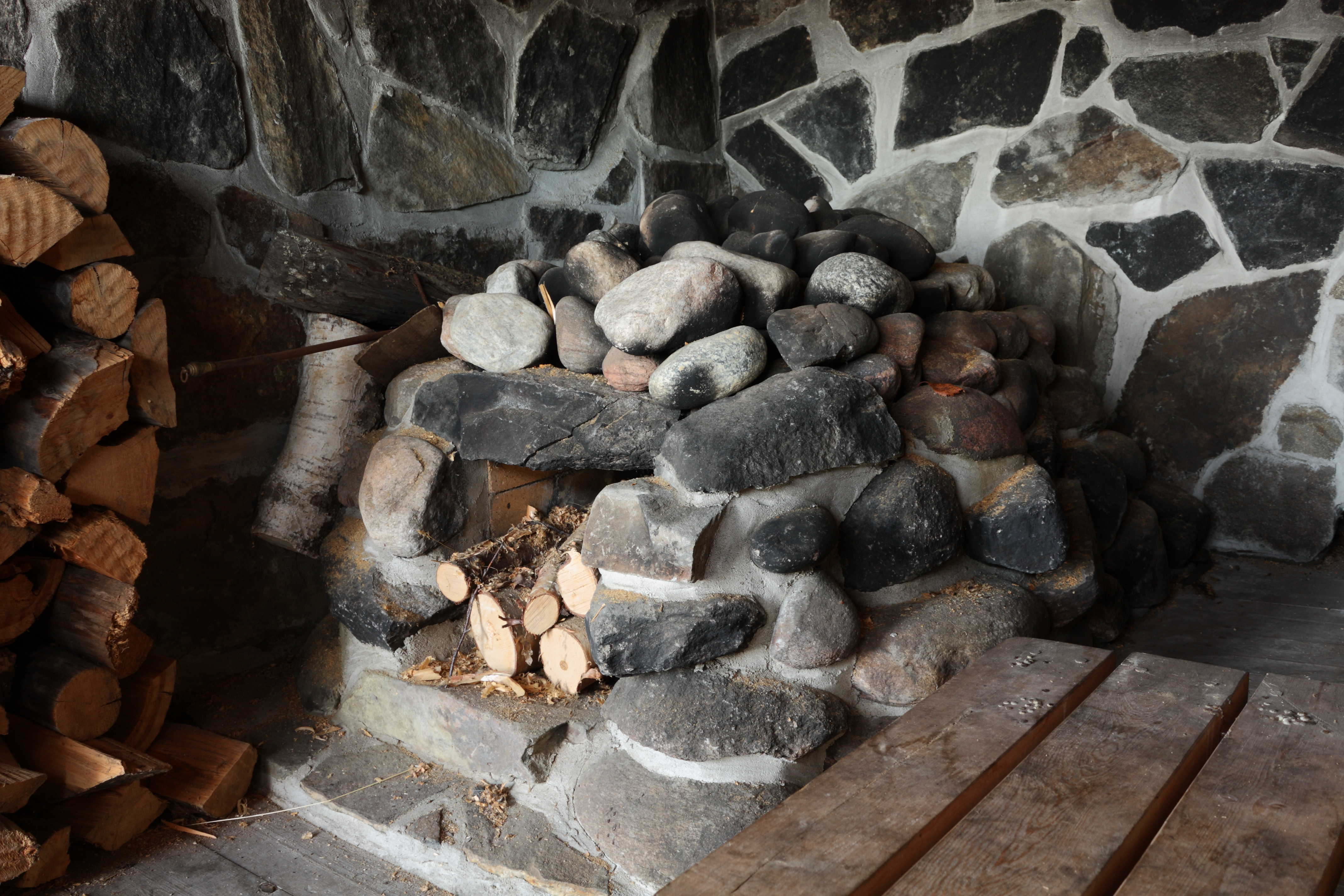
A traditional wood-burning sauna stove — called a kiuas in Finnish — uses combustion to heat a stone pile positioned above the firebox. The stones act as a thermal buffer, storing heat during the firing phase and releasing it gradually once the fire dies down. Cedar interiors pair well with wood-burning stoves because the radiant and convective heat produces the high relative humidity typical of Finnish-style bathing.
Output Range and Room Sizing
Stove manufacturers generally rate output in kilowatts of effective heating capacity. As a rough guideline, an 8 kW stove handles a well-insulated sauna cabin of approximately 7–9 m³ internal volume. For larger rooms — 12 to 18 m³ — outputs of 12–16 kW are typical. These figures assume standard insulation: 100 mm mineral wool between the vapour barrier and exterior wall, and a properly sealed cedar interior lining with no cold bridges.
In Poland, wood-burning sauna stoves installed inside a building must comply with the requirements of the Polish Fire Protection Act (Dz.U. 2018 poz. 620) and PN-EN 15821 for the stove itself. A chimney flue with adequate draft — typically a minimum 5-metre height above the firebox — is mandatory. Local municipality regulations may add conditions on chimney sweep inspections.
Fuel and Operating Costs
Birch and alder are the traditional firewood species used in Polish saunas. Dry birch with moisture content below 20% burns more completely and produces less creosote build-up than green wood. Firewood cost varies by region; in rural areas near forested regions (Podkarpacie, Warmia-Mazury) the cost per session is often lower than electricity at comparable heat output.
Wood-burning stoves typically take 45–90 minutes to bring a cedar sauna room from ambient to 80°C, depending on stone mass and insulation quality. Electric heaters can reach operating temperature faster — often within 30–40 minutes — but lack the distinctive radiant quality of a wood fire.
Electric Sauna Heaters
Electric sauna heaters pass current through resistive elements positioned inside a steel housing filled with sauna stones. The design is straightforward: the resistance elements heat the stones, and the stones heat the room both through convection and through steam generation when water is ladled onto them.
Installation Requirements
In Polish residential buildings, sauna heaters above 3.5 kW require a dedicated 400V three-phase circuit installed by a licensed electrician under PN-HD 60364-7-703. The heater must include an integrated timer and temperature limiter — both required under the same standard. Many European-market heaters from Finnish and German manufacturers (Harvia, Tylö, EOS, Helo) include these as standard features.
Control and Convenience
Electric heaters offer precise temperature control and can be pre-programmed to reach operating temperature before occupancy — a practical feature in Polish winters where leaving the sauna cold until the last minute wastes time. Remote-control and smartphone-connected controllers are available as accessories for most current production models.
Infrared Panels
Infrared panels differ fundamentally from conventional sauna heaters. Rather than heating the air to 80–100°C, they emit medium- or far-infrared radiation that is absorbed directly by the body and by the cedar surfaces of the room. Operating temperature is typically 45–60°C — low enough that the session is physiologically different from a traditional Finnish sauna.
Cedar Compatibility
Cedar's low thermal mass makes it a good radiating surface in infrared cabins. The wood warms quickly and contributes a secondary diffuse radiance across the interior. Cedar also performs well at the lower humidity levels typical of infrared sessions, where the wood faces less condensation stress than in steam-heavy Finnish bathing.
Electrical Demand
A typical 2-person infrared cedar cabin uses 1.5–2.5 kW total panel output, which falls within single-phase household circuit capacity. Installation does not require a licensed electrician in the same category as high-power electric heaters, though the cabin assembly should still be earthed per PN-HD 60364.
Comparison Summary
Wood-Burning Stove
Typical output: 8–18 kW | Warm-up: 45–90 min | Fuel: Dry firewood (birch, alder) | Requirement: Chimney, fire protection compliance | Style: Traditional Finnish (high humidity possible)
Electric Heater
Typical output: 3.5–18 kW | Warm-up: 30–45 min | Fuel: Electricity (400V 3-phase above 3.5 kW) | Requirement: Dedicated circuit, licensed installation | Style: Traditional Finnish (steam capable)
Infrared Panels
Typical output: 1.5–3 kW | Warm-up: 10–20 min | Fuel: Standard household electricity | Requirement: Earthed single-phase circuit | Style: Low-temperature infrared (dry, no steam)
External References
- Polish technical and construction requirements (gov.pl)
- Harvia Sauna Heater Guide
- WHO: Sauna and Health
Last updated: June 2026